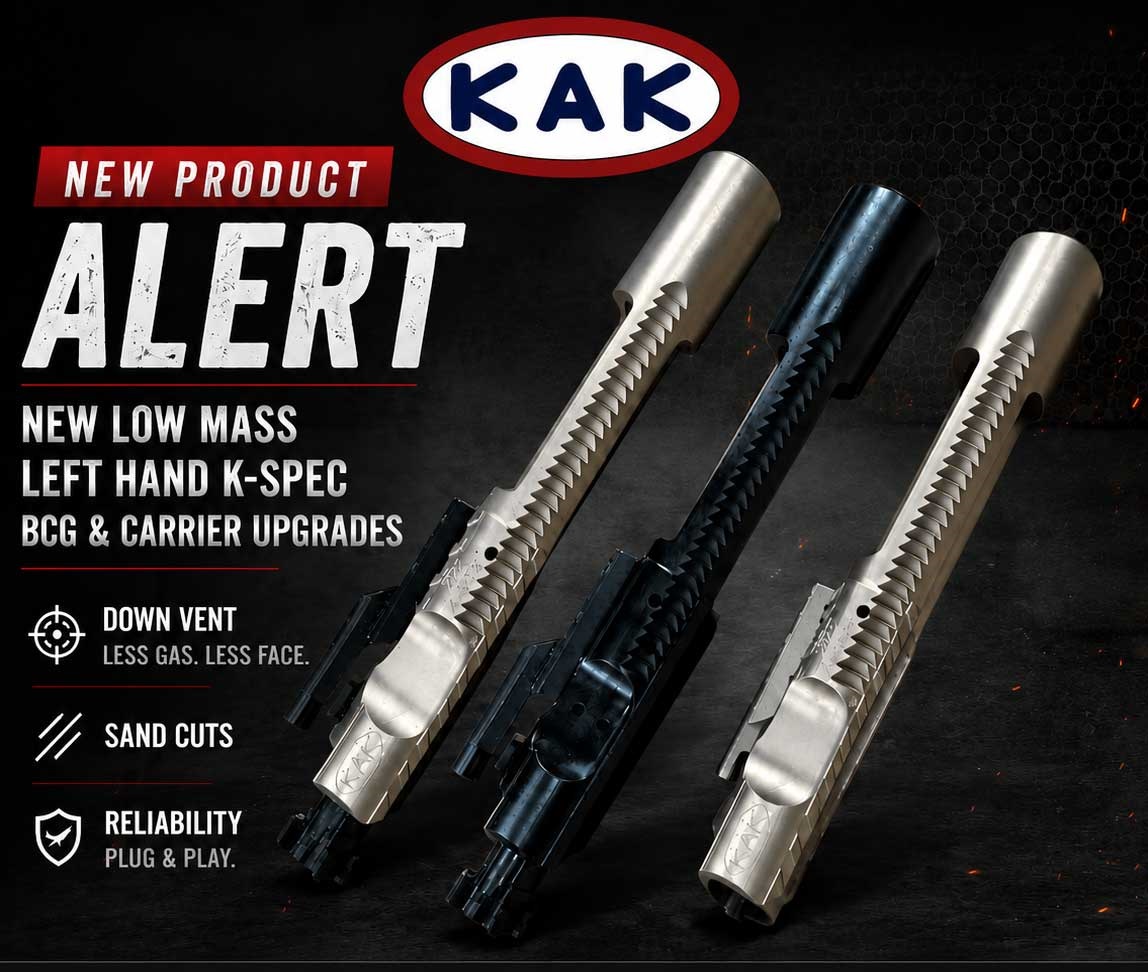
KAK Industry Left Hand K-SPEC Bolt Carrier Groups | The Gun Shop
Pros & cons
What works
- Weighs 11.8 oz — Proprietary K-SPEC carrier dimensions optimize gas flow for suppression.
- 1.165-inch carrier key length — Reduces initial gas volume entering the carrier by approximately 12% versus mil-spec.
- Four-point hexagonal staking on gas key — Exceeds mil-spec for suppressor-level backpressure.
- MPI-marked C158 bolt — Validated magnetic particle inspection for critical stress areas.
Trade-offs
- Does not include left-handed cam pin or firing pin — Adds $35-$55 in necessary additional parts.
- Carrier body width of 1.480 inches — May contact interior of some ultra-slim billet left-handed uppers.
- $693 price point — Justifiable only for dedicated suppressed builds, not general left-handed use.
- Semi-auto profile only — Not rated for full-auto or high-volume binary trigger use.
Video review
Expert review
Specs at a glance
About this product
The KAK Industry Left Hand K-SPEC Bolt Carrier Group (BCG) is a southpaw-specific, semi-automatic-only carrier group engineered for suppressed left-handed AR-15 builds. It features a full-auto profile carrier machined to KAK's proprietary K-SPEC dimensions for enhanced gas efficiency. You are looking at a professional-grade component designed to address extraction timing and port pop in left-handed uppers, not a mirrored mil-spec part.
What is the KAK Industry Left Hand K-SPEC Bolt Carrier Group used for?
This Left Hand K-SPEC BCG is specifically for building or converting a standard AR-15 to a left-hand-ejecting configuration for suppressed, semi-automatic use. The reversed cam pin path alters bolt timing to match the reversed port geometry of a left-handed upper receiver, ensuring reliable extraction and mitigating gas blowback. I recommend it for competition shooters running suppressors or builders who experience excessive port pop with standard carriers in left-handed uppers.
How does the KAK Industry Left Hand K-SPEC compare to a standard LMT Enhanced Bolt Carrier?
For suppressed left-handed builds, the KAK K-SPEC offers better initial gas port seal due to its 1.165-inch carrier key length—0.065 inches shorter than the LMT Enhanced—while the LMT remains superior for hard-use, full-auto applications with its dual ejector bolt design. The KAK's dimensional tuning is more specialized for gas mitigation in a semi-auto, left-handed platform, whereas the LMT Enhanced is an overbuilt, ambidextrous solution. This makes the KAK the more precise tool for this specific job.
What does it weigh and what are the dimensions?
The KAK K-SPEC carrier group weighs 11.8 ounces complete, with a critical carrier body width of 1.480 inches and an overall length of 7.625 inches. The bolt itself features a 0.136-inch gas port diameter, which is standard for a carbine-gas system. These dimensions control dwell time and ensure compatibility with most left-handed upper receivers, though you should verify channel clearance if using an ultra-lightweight billet upper like those from Christensen Arms.
Who is this NOT for?
This BCG is not for right-handed shooters, full-auto registered lower receivers, or builds without a suppressor. The reversed cam pin path makes it non-functional in a standard right-handed upper. Its gas-tuning is optimized for suppressed operation; in an unsuppressed rifle, you may experience short-stroking with an under-gassed barrel. If you're building a standard right-handed rifle, a phosphate-coated Mil-Spec BCG from a source like our coating comparison article is a more cost-effective choice.
What's in the box?
The package includes the complete left-handed bolt carrier group, a properly staked gas key torqued to 45 in-lbs, one C158 carpenter steel bolt with a magnetic particle inspected (MPI) marking, and a single chrome-silicon extractor spring. It does not include a cam pin, firing pin, or cotter pin—you must source left-handed specific versions of those components separately. KAK ships it in a single-layer foam insert, not a hard case.
Is the KAK Industry Left Hand K-SPEC BCG worth it at $693?
At $693, this BCG is worth the investment only if you are committed to building a dedicated, suppressed, left-handed AR-15 and have exhausted tuning options with standard carriers. The price reflects the low-volume machining of a reversed component and the proprietary gas tuning. For a builder who values eliminating gas face and tuning their rifle to a specific load, this is a justifiable final-step component. For a casual left-handed shooter with a right-handed upper, it is an unnecessary expense.
Key attributes
| Platform | AR-15 |
| Eject Orientation | Left Hand |
| Carrier Profile | Full-Auto (Semi-Auto Use) |
| Bolt Material | C158 Carpenter Steel |
| Bolt Treatment | MPI Tested |
| Gas Key Staking | 4-Point Hexagonal |
| Carrier Finish | Nitride |
| Weight | 11.8 oz |
Frequently asked questions
- Is it compatible with all left-handed AR-15 uppers?
- Yes, it is compatible with most forged and billet left-handed uppers from brands like Stag Arms and Gibbz Arms. However, you must verify internal channel clearance in ultra-slim billet designs, as the 1.480-inch carrier body width may contact the interior walls during cycling. Allow for a 0.015-inch minimum clearance on all sides.
- Does this BCG work with a standard AR-15 firing pin?
- No, it requires a left-handed firing pin due to the reversed orientation of the bolt and carrier. A standard firing pin will not align correctly with the bolt's channel. You must source a left-handed specific firing pin from KAK Industry or a retailer like The Gun Shop to complete the assembly.
- How long does shipping take for this item?
- Processing and shipping typically take 3-5 business days for in-stock items, as these are low-volume components shipped direct from The Gun Shop's distributor network. Express shipping options can reduce transit time to 2 business days once the order is processed, but availability is subject to distributor stock levels.
- Can I return it if it doesn't fit my upper receiver?
- Returns are only accepted if the component is unused, in its original packaging, and the fitment issue is verified as a manufacturer defect. Due to the specialized nature of left-handed parts, standard fitment issues with aftermarket uppers generally do not qualify. Contact The Gun Shop's gunsmithing department for a fitment consultation before purchasing to avoid issues.
- Does this work with a .223 Wylde chamber?
- Yes, the bolt head is chambered for 5.56 NATO, which is fully compatible with .223 Wylde barrels. The 0.136-inch bolt gas port is optimized for a carbine-length gas system on a 14.5-inch to 16-inch barrel; you may need to adjust buffer weight for optimal timing with longer gas systems, as detailed in <a href="/blog/ar-15-buffer-weight-tuning-suppressed-sbr/">our tuning guide</a>.
- Is the gas key properly staked?
- Yes, the gas key is torqued to 45 in-lbs and staked in four locations using a hexagonal punch pattern, which exceeds the typical two-stake mil-spec standard. This staking pattern provides superior resistance to carrier key loosening under sustained fire, a critical detail for suppressed operation where backpressure is increased.