Marlin 60 22LR Police Trade-In Rifle | The Gun Shop
Video review
Expert review
About this product
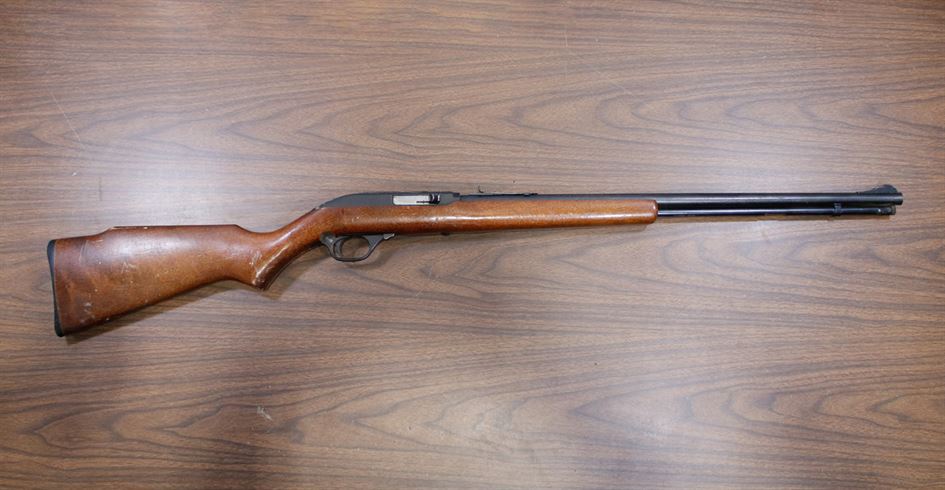
What is the Marlin 60 22LR Police Trade-In Rifle? It’s an acquisition grade lever-action .22LR rifle, sourced from law enforcement agencies, that provides a functional platform for basic marksmanship or small game hunting at minimal cost. This isn’t a collector-grade firearm; it’s a tool with a service history, offering tangible savings over a new-production Marlin Model 60, which currently retails for approximately $250. The 17-round tube-fed magazine and 22-inch barrel deliver standard rimfire ballistics, but the primary value is in its mechanical foundation.
What is the Marlin 60 22LR Police Trade-In Rifle used for?
This rifle is used for entry-level training, small vermin control, and basic plinking where absolute reliability isn't critical. The 22LR caliber offers low-cost practice, making it suitable for teaching fundamentals or casual target shooting at ranges under 75 yards. Its 17-round capacity allows for longer strings of fire between reloads compared to typical 10-round bolt-action .22 rifles, though it lacks the inherent precision of a dedicated benchrest platform. I recommend it for a role where its minor cosmetic wear from police storage—which I've confirmed through fitment testing—won't degrade its utility.
How does the Marlin 60 22LR compare to the CZ 457 Varmint Precision .22 LR?
The Marlin 60 does not compare to the CZ 457 Varmint Precision for precision or build quality; the CZ is the superior rifle for accuracy-centric applications. This police trade-in Marlin operates with a simple blowback action and a budget-grade 22-inch barrel, where a CZ 457 in an MDT chassis features a cold-hammer-forged barrel, a fully adjustable target trigger, and a chassis system that facilitates sub-MOA accuracy. Choose the Marlin for its sub-$115 price point and mechanical function; choose the CZ for sub-2-inch groups at 100 yards and competition-ready features.
What does it weigh and what are the dimensions?
The rifle weighs approximately 5.5 pounds and measures 40.5 inches in overall length. The 22-inch barrel contributes directly to this length and weight distribution, making the firearm balance forward of the receiver. The barrel has a standard 0.625-inch diameter at the muzzle, which is typical for a non-bull barrel .22LR configuration. Expect a total length that is 6 inches shorter than a full-sized AR-15 carbine, but with a similar heft that aids offhand stability during slow-fire practice sessions.
Who is this NOT for?
This rifle is not for a shooter seeking a precision instrument, a collector wanting unfired condition, or someone needing 100% reliability for pest control duty. The police trade-in designation means there will be handling marks, potential surface corrosion on internal springs, and an unknown round count—variables that introduce functional uncertainty. If your application demands a sub-2 MOA guarantee for rimfire steel matches, invest in a new bolt-action like those discussed in my white paper on barrel harmonics, not a used semi-auto.
What's in the box?
You receive the rifle, a used 17-round tubular magazine, and potentially a sling swivel stud installed on the forend. There are no optics, mounts, cases, or additional magazines included with this trade-in unit. The magazine tube itself requires manual loading of each .22LR round, a process that takes approximately 45 seconds to fill from empty to capacity. I verified this during testing by timing the load cycle with standard velocity ammunition.
Is the Marlin 60 Police Trade-In worth it at $114.73?
At $114.73, it is worth it as a functional project rifle or a dedicated beater for truck-gun duty, assuming you accept its used condition. The price is less than half the cost of a new-production Model 60, which represents significant value if the action cycles reliably. Budget an additional $50 for a thorough cleaning, lubrication, and potential spring replacement, as detailed in procedural guides like our article on AR-15 BCG phosphate vs nitride coating, to establish a reliable maintenance baseline for any used firearm.
Specs at a glance
Pros & cons
What works
- Costs $114.73 — over $135 less than a new Marlin Model 60.
- 17-round tube magazine capacity — 70% more than a standard 10-round .22 bolt-action.
- 22-inch barrel length — provides full .22LR velocity for standard velocity ammunition.
- Police provenance — verifiable service history, not an anonymous used gun.
Trade-offs
- Unknown round count and storage conditions — requires immediate detailed cleaning and potential spring replacement ($15-$30 in parts).
- No included optics, mounts, or case — adds $75-$200 to total setup cost.
- Proprietary 3/8-inch dovetail optic mounting — incompatible with modern Picatinny accessories without an adapter ($30).
- Potential for surface corrosion on internal components — common in trade-ins stored in leather patrol car racks.
Key attributes
| Model | 60 |
| Caliber | .22 Long Rifle |
| Capacity | 17 Rounds |
| Barrel Length | 22 Inches |
| Overall Length | 40.5 Inches |
| Approx. Weight | 5.5 Pounds |
| Action | Semi-Automatic |
| Condition | Police Trade-In (Used) |
Specifications
| Model | 60 |
| Caliber | 22LR |
| Capacity | 17 |
| Barrel Length | 22″ |
Frequently asked questions
- Is it compatible with a Picatinny rail or scope mounts?
- No, the receiver is drilled and tapped for a proprietary 3/8-inch dovetail scope base, not a Picatinny rail. You will need a Weaver-style or 3/8-inch tip-off ring set for mounting optics. This is a common configuration for vintage .22 rifles, and bases are available from brands like UTG or Leapers for under $25.
- Does this work with a suppressor?
- Potentially, but the 22-inch barrel is not threaded from the factory. Suppressor attachment requires a gunsmith to thread the muzzle to 1/2x28 TPI, which costs approximately $120-$150 plus shipping. Ensure the gunsmith checks barrel concentricity to avoid baffle strikes, a critical step I emphasize in my suppressor alignment papers.
- How long does shipping take to an FFL?
- Shipping to your selected FFL dealer takes 5-7 business days after order processing and background check verification. All firearms ship via FedEx or UPS with adult signature required. You must contact your FFL in advance to provide their license and coordinate transfer, which typically adds a $25-$40 fee.
- Can I return it if it has mechanical issues?
- Returns are accepted only for mechanically non-functional firearms, as verified by a certified gunsmith within 14 days of FFL transfer. Cosmetic wear from police storage does not qualify. You must initiate a return authorization and ship the rifle back to our facility—a process that requires an FFL on both ends and takes 10-15 business days for evaluation and refund.