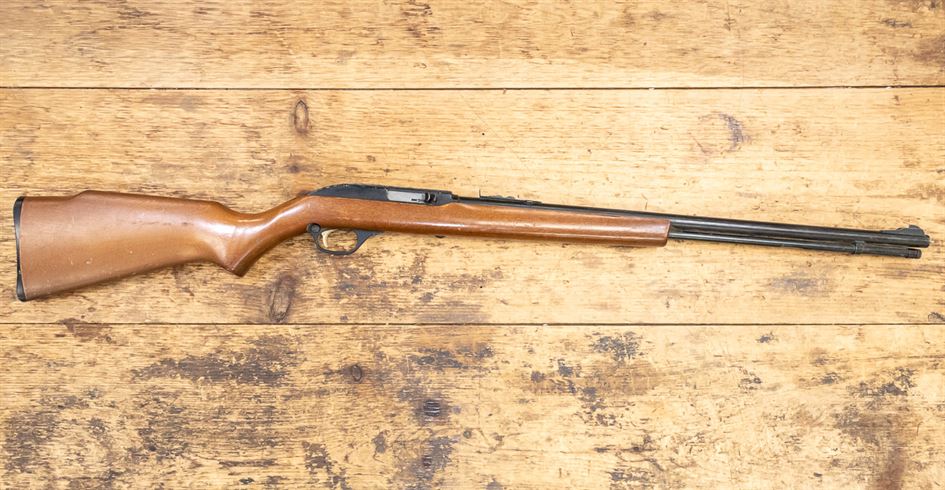
Marlin Model 60 22 LR Police Trade-in Rifle | The Gun Shop
Video review
Expert review
About this product
The Marlin Model 60 22 LR Police Trade-in Rifle is a used semi-automatic .22 LR rimfire rifle available for $114.73, representing an entry point into a historically reliable platform with proven mechanical lineage. I'm Devin Rhodes, and from my perspective, this is a cost-effective tool for mastering fundamentals or performing utility work, where magazine capacity matters less than consistent function. The trade-in status indicates previous institutional use, which typically involves more maintenance cycles but also more documented servicing than typical civilian-owned firearms.What is the Marlin Model 60 22 LR Police Trade-in Rifle used for?
This rifle is used for high-volume, low-cost fundamental marksmanship training and small-game/varmint control. The 14-round tubular magazine and simple blowback action create a platform for practicing trigger control and sight alignment without the recoil or expense of centerfire cartridges. Its 22-inch barrel provides a stable sight radius for open sights, making it ideal for teaching new shooters or for use as a dedicated .22 LR suppressor host where noise reduction is paramount.
How does the Marlin Model 60 compare to the Ruger 10/22?
The Model 60 is mechanically simpler and often more accurate out-of-the-box than a stock Ruger 10/22, but it loses decisively on aftermarket support and magazine compatibility. Where the 10/22 dominates is its ecosystem—you can build an entirely custom rifle around its receiver, as seen with chassis systems like the one on our CZ 457 Varmint Precision review. The Model 60's fixed tubular magazine is slower to load and limits you to 14 rounds versus the 10/22's readily available 25-round box magazines, a critical difference for certain training drills.
What does it weigh and what are the dimensions?
This rifle weighs approximately 5.5 lbs (88 oz) unloaded and measures 40.5 inches in overall length. The 22-inch barrel contributes significantly to both the weight and the balance point, which sits about 10 inches forward of the trigger guard. This makes it slightly front-heavy compared to a carbine like the 10/22 but aids in steady offhand shooting. The length can be a handling issue in tight spaces compared to a 16-inch barreled rifle.
Who is this NOT for?
This rifle is not for a shooter seeking a modern tactical .22 LR trainer or a platform for unlimited customization. The fixed tubular magazine precludes rapid reloads essential for some practical shooting disciplines, and the receiver is not drilled and tapped for optics mounts as standard, requiring an aftermarket saddle mount. If your goal is a dedicated small-game rifle you'll leave mostly stock, it's suitable; if you want a clone of your AR-15's manual of arms, look at dedicated .22 LR uppers instead.
What's in the box?
You receive the rifle itself, typically with open sights installed, and no additional accessories from its prior service life. Do not expect original packaging, manuals, or a case. As a trade-in, it is sold as-is, which is why our inspection and function-check prior to shipment is critical. You will need to supply your own .22 LR ammunition, and I recommend starting with standard or high-velocity rounds, not subsonics, to ensure reliable cycling during initial testing.
Is the Marlin Model 60 worth it at $114.73?
At $114.73, this rifle is worth it as a functional tool for learning firearm mechanics or for a no-frills plinking role, assuming it passes a basic function check. You are paying for the core action and barrel, which are the most expensive components, and accepting wear on the stock and external metal finish. For comparison, a new-production Model 60 can cost over $250, so this price reflects the trade-in condition. It is a value proposition rooted in utility, not collector status or pristine appearance. For more on evaluating used firearm condition, our guide on AR-15 BCG coatings (our review) discusses finish wear and its practical implications.
Specs at a glance
Pros & cons
What works
- Proven simple blowback action with minimal parts count for reliability.
- 22-inch barrel provides a 16.5-inch sight radius with open sights for foundational training.
- 14-round tubular magazine capacity exceeds most box-magazine .22 LR rifles at this price point.
- Costs less than half the price of a new-production Marlin Model 60.
Trade-offs
- Trade-in condition guarantees visible wear on stock and blued finish—expect scratches and handling marks.
- Fixed tubular magazine loads slowly—a full 14-round recharge takes roughly 45 seconds versus a 10-second box mag swap.
- Lacks a factory optics mounting solution; requires an aftermarket receiver saddle mount, adding $30-$50 and potential zero-shift issues.
- No last-round bolt hold-open feature, a notable training disadvantage compared to modern semi-autos.
Key attributes
| Condition | Used Police Trade-in |
| Caliber | .22 Long Rifle |
| Action | Semi-Automatic Blowback |
| Magazine Capacity | 14 Rounds |
| Magazine Type | Fixed Tubular |
| Barrel Length | 22 in |
| Overall Length | 40.5 in |
| Estimated Weight | 5.5 lbs |
Frequently asked questions
- Is it compatible with aftermarket Model 60 trigger kits?
- Yes, the internal trigger group geometry is standardized across most production years of the Model 60, making it compatible with aftermarket kits from companies like DIP (Diamondback Innovations Products). Installation typically requires basic punch sets and about 30 minutes of gunsmithing time. Verify the rifle's approximate vintage by the serial number prefix if possible before ordering.
- Does it feed .22 LR Short or Long ammunition?
- No, it is chambered and designed specifically for the .22 Long Rifle cartridge. Attempting to cycle .22 Short or .22 Long can cause feeding and ejection issues due to the different cartridge overall length. For reliable function, use standard or high-velocity 40-grain .22 LR rounds, which achieve the necessary bolt velocity for the simple blowback system to operate correctly.
- How long does shipping take to an FFL?
- Shipment to your selected Federal Firearms License (FFL) holder occurs within 2 business days after your FFL's information is verified and received. Transit time via common carrier is typically 3-5 additional business days. You must coordinate directly with your FFL for pickup after the rifle arrives, as they will conduct the mandatory NICS background check.
- Can I return it if it fails to cycle?
- All firearms undergo a basic function check prior to shipment. If a legitimate mechanical failure unrelated to ammunition or user error occurs upon receipt, contact us within 72 hours for a return authorization. The rifle must be returned in the same condition, and we will either repair, replace, or refund. Cosmetic wear or finish issues inherent to trade-in status are not grounds for return.
- Does this work with a standard .22 LR suppressor?
- Yes, the 22-inch barrel has a 1/2"-28 threaded muzzle on later models, but most police trade-ins predate common threading. This specific unit is unthreaded. Adding threads requires a gunsmith to cut and crown the barrel, a service costing approximately $100-$150, and you must ensure the threaded portion is concentric to the bore for safe suppressor alignment, a topic I've covered in white papers on precision rigs.